


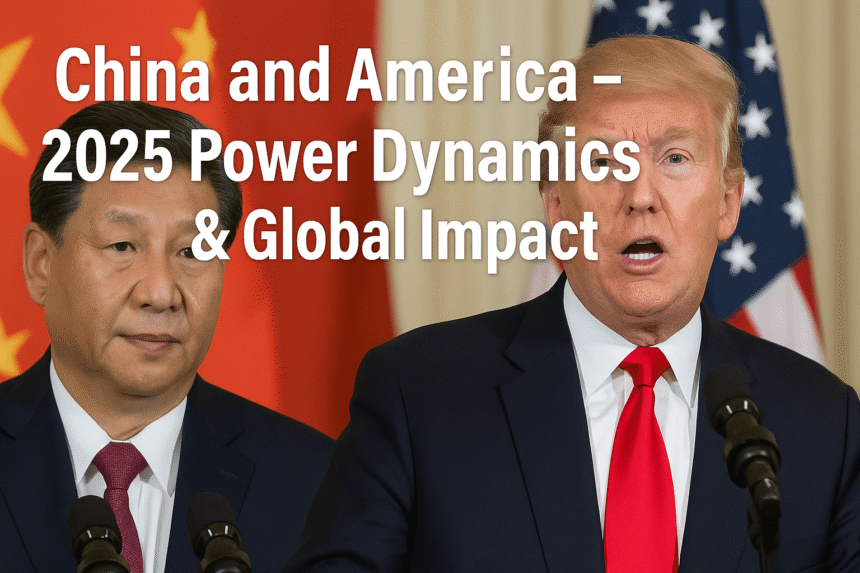
In 2025, the relationship between China and America continues to shape the global order. From economic competition to technology rivalries, and strategic influence in Asia and Africa, their evolving rivalry influences markets, security, and daily life worldwide. In this deep analysis, we unpack ten key areas defining the China‑America dynamic.
1. Economic Power & Trade Competition
Today, the United States remains the world’s largest economy at ~$27 trillion, while China, at ~$18 trillion, holds the second position. The trade war from earlier years has transitioned into strategic competition—each side now focuses on supply chain resilience, critical technologies like semiconductors, and efforts to reduce dependency.
- U.S. pass-through tariffs adjusted, targeted on tech & rare earths.
- China’s “Dual Circulation” strategy invests in domestic innovation and self-reliance.
- Both nations ink multilateral trade agreements to counterbalance each other.
2. Technology & AI Rivalry
The tech battlefield now includes AI, 5G, and advanced semiconductors. The U.S. maintains advantage in chip design (via NVIDIA, AMD), while China advances its domestic semiconductor ecosystem with companies like SMIC and Huawei’s revival.
- U.S. created new export controls on AI chips and EDA software.
- China doubles down on its “Made in China 2025” goal for chip self-sufficiency.
- Cross-border tech investment and AI standard-setting play key roles.
3. Geopolitical Positioning & Alliances
China’s global influence continues to grow through Belt & Road Initiative (BRI), with infrastructure projects in Asia, Africa, Latin America. The U.S. counters with strategic allies via Indo‑Pacific Strategy: QUAD, AUKUS, and ASEAN partnerships.
- U.S. bolsters military presence in Asia-Pacific through agreements with Japan, Australia, India.
- China signs new BRI deals in Africa and Latin America.
- Global south countries increasingly balance between both powers via equitable engagement.
4. Military Balance & Strategic Risks
The U.S. retains unmatched global military leadership, though China invests heavily in naval capability and missile systems. South China Sea tensions and Taiwan’s defense strength symbolize flashpoints.
- U.S. reaffirms Taiwan Support Act; arms sale grows.
- China military exercises increase near Taiwan and opposing U.S. presence.
- Email: Coldfast → AI‑enabled PAC‑3 defense systems deployed on both sides.
5. Climate Leadership & Sustainability
Despite competition, climate collaboration remains vital. The U.S. plans 50% CO₂ reductions by 2030; China aims carbon neutrality by 2060. They cooperate in areas like EV supply chains, solar manufacturing, and clean technology investments.
- U.S.–China Summit on Climate discussed shared carbon capture and clean energy goals.
- Trade tariffs eased for renewables equipment.
- Joint research into battery tech and green hydrogen underway.
6. Cultural & Soft Power Engagement
China’s global presence includes Confucius Institutes, digital platforms (TikTok), and cultural diplomacy. The U.S. counters with Hollywood media, global education, and exchange programs.
- China adds new Confucius centers in Africa and Latin America.
- American universities remain premier for international students.
- Media platforms shape narratives and global engagement.
7. Financial Rivalry & Currency Markets
The debate on the US dollar vs. RMB intensifies. China pushes digital RMB currency and internationalizes the RMB, while the U.S. maintains dollar primacy via Treasury exchanges and U.S. sanctions enforcement.
- New cross-border CBDC pilots examined for digital payments.
- China held record-high foreign reserves at $3 trillion.
- Global trade still largely denominated in U.S. dollars.
8. Human Rights & Global Governance
Democratic vs. state-backed governance becomes a heated theme. Western nations criticize China over Xinjiang and Hong Kong; China responds with non-interference principles and counters via UN and BRICS diplomacy.
- U.S. and EU reaffirm visa limits on Chinese officials.
- BRICS expands its global development bank as alternative to Western institutions.
- China promotes global digital governance at ITU and ICANN.
9. Innovation & Future Industries
Who leads next-generation sectors? U.S. dominates biotech, AI, aerospace. China pushes saturation in AI, renewable energy, EVs, and genomic technologies.
- China’s biotech funds rose 45% in 2024.
- U.S. increases semiconductor R&D via CHIPS Act.
- Both nations race in space and AI autonomy.
10. Consumer Markets & Global Brands
American brands (Apple, Nike) remain popular in China, despite restrictions. Meanwhile, Chinese brands (BYD, DJI) expand globally. E-commerce giants in both countries launch cross-border platforms.
- Local adaptation key to entering each market.
- Localization of services and brands critical for global adoption.
- Brand loyalties blurred; cross-border players increasing.
Implications for Investors & Businesses
- Fund global indices vs. China-specific tech ETFs.
- Diversify through ASEAN-linked supply chains.
- Adopt ESG frameworks acceptable to both markets.
How Individuals Feel the Impact
- Hard goods prices shift depending on import/export policies.
- Travel safety, visas, cultural exchange fluctuate.
- Career opportunities increase as tech and offshoring trends evolve.
Key Internal Resources
High-Authority External Sources
- IMF – World Economic Outlook 2025
- Pew Research – Global Attitudes
- Brookings – U.S.–China Relations
Conclusion: A Dual-Track Race Between Giants
The dynamic between China and America in 2025 is a complex mix of competition and strategic cooperation. While rivalry spans economics, technology, geopolitics, and ideology, collaboration remains possible—especially around climate, public health, and global stability. How this power relationship evolves will define global trends in the next decade and shape every nation’s future.
Tags: China and America, US China relations, tech rivalry, global power, 2025 geopolitics, trade dynamics